
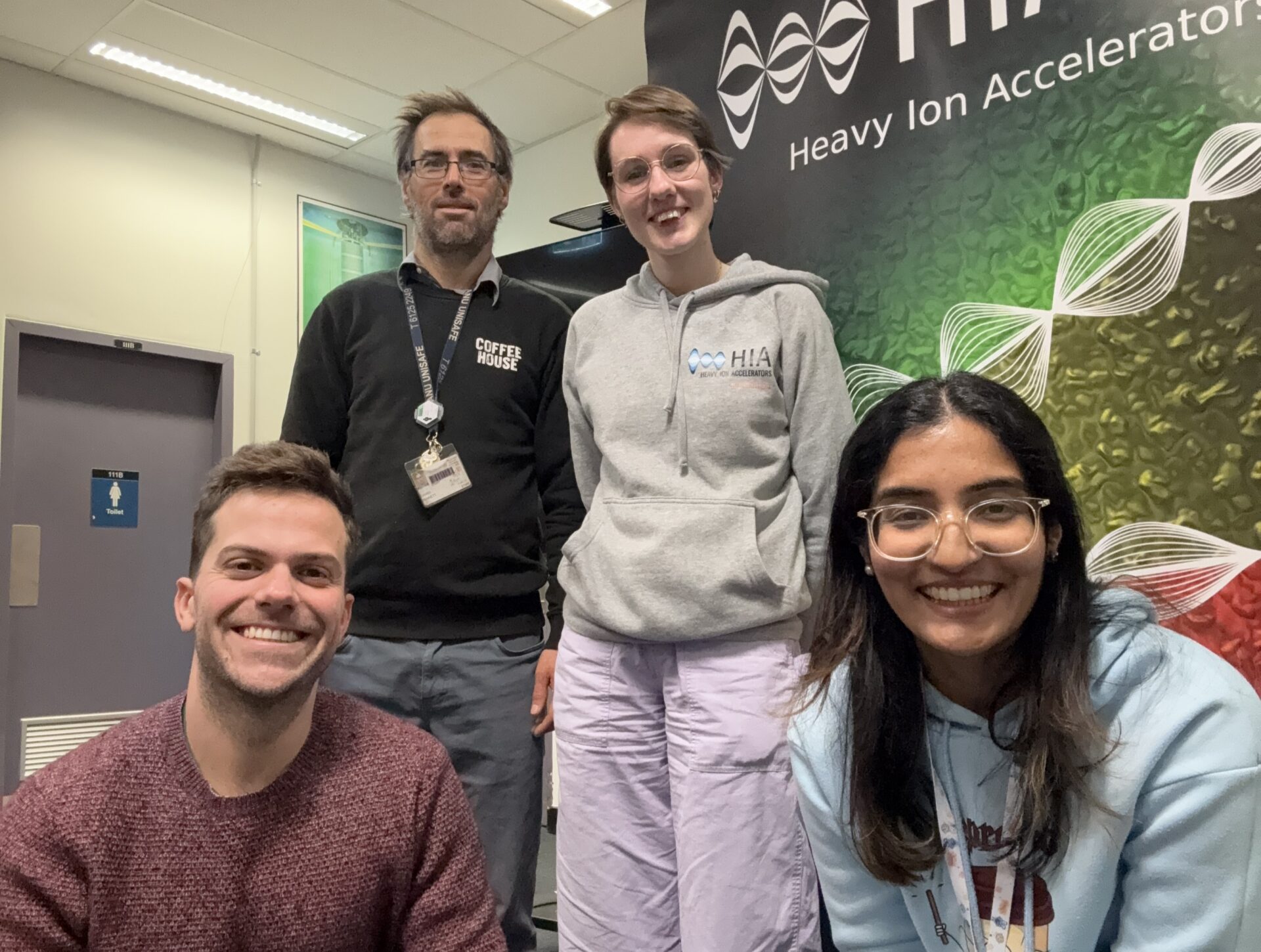
At HIA’s Heavy Ion Accelerator Facility (HIAF) based at The Australian National University, Canberra, an electronic chip tiny enough to sit on a fingertip has been tested for potentially very big jobs: operating near particle collisions at CERN’s Large Hadron Collider and, one day, in deep space missions.
Most chips live inside phones, laptops and household appliances. They’re designed to handle some heat, electrical noise and perhaps the occasional stray cosmic ray. But in space, or close to particle collisions inside the Large Hadron Collider, a chip must keep working while facing a relentless barrage of radiation.
Associate Professor Jafar Shojaii and Dr Andrea Mazzanti from Macquarie University are leading the design of a new radiation-hardened FPGA, or field-programmable gate array, alongside collaborators from Italy’s National Institute for Nuclear Physics.
“The chip we designed is intended as a candidate for use in CERN’s VELO vertex detector, close to the proton collisions in the LHCb experiment,” Associate Professor Shojaii said.
CERN is preparing to upgrade the LHCb to enable higher-luminosity operation. That means more collisions and more data, but much harsher radiation conditions for electronics close to the beam.
“They will need to withstand a dose of one gigarad—about a thousand times more radiation than a space satellite receives over a long-term mission,” Shojaii said.
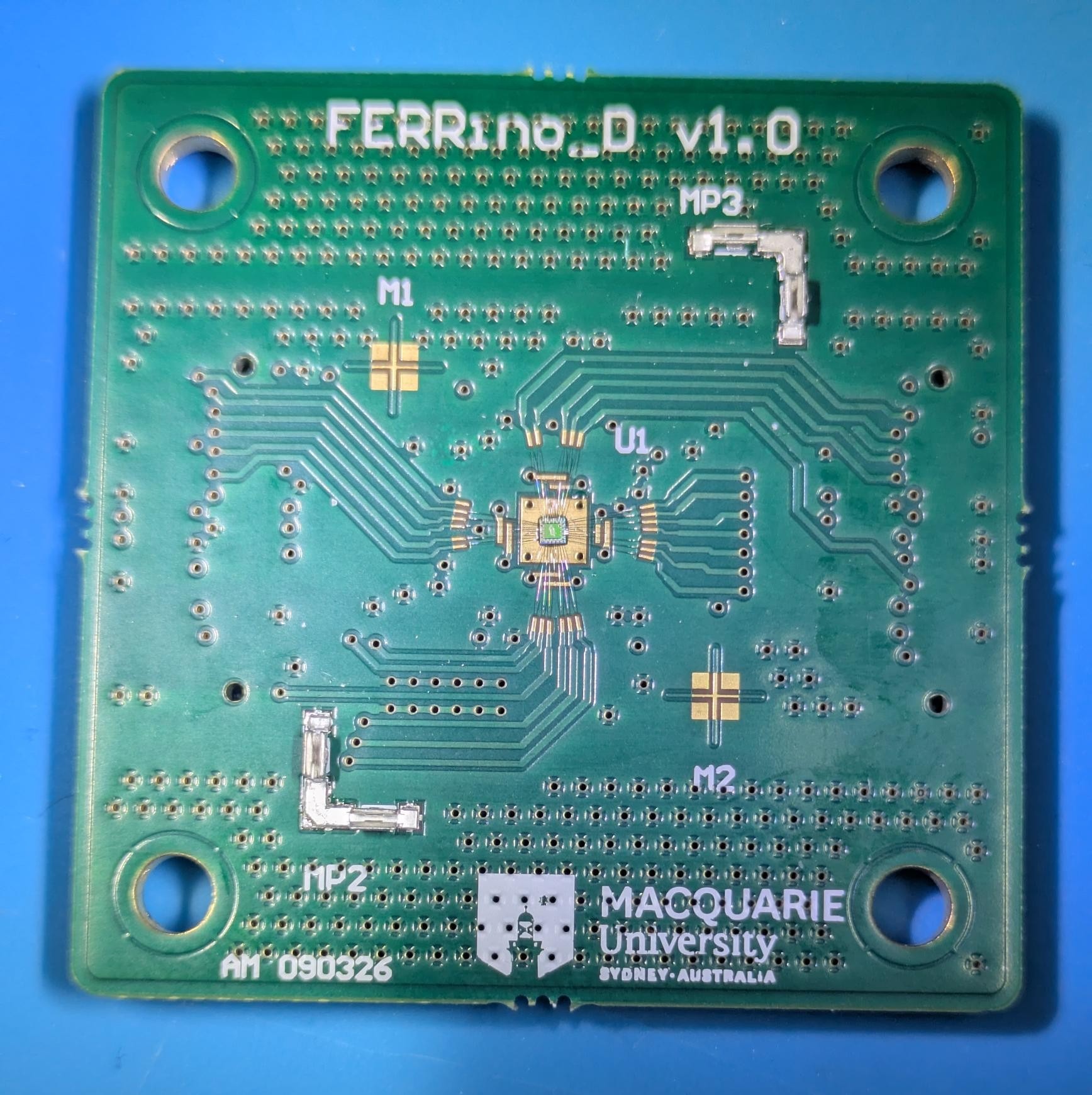
The new chip measures just four millimetres across but fits around eight million nanoscale transistors. That leaves very little margin for error when high-energy particles strike.
To test the design, Shojaii and Mazzanti returned to HIAF, having previously used the facility for another radiation-testing project. They knew it could provide the specialist beam capability and technical support their new work required.
“HIAF’s capability is critical because it provides the highest-energy heavy-ion beams available in Australia for the testing we need to do,” Shojaii said.
HIA staff worked with the Macquarie team to plan and simulate the experiment, then operated the Space Irradiation Beamline to expose the prototype to nine different species of ion beam. Each beam species, ranging from boron to germanium, impacted the chip with a different energy to emulate a range of radiation conditions. At the same time, the Macquarie team measured the chip’s performance.
The test delivered good news: under the HIAF test conditions, the chip performed as intended, demonstrating its ability to withstand extremely high radiation levels.
“This is the first time in Australia that we’ve developed chips with radiation hardening that can tolerate doses of radiation up to 1 gigarad,” Shojaii said.
The benefits extend beyond this one prototype. Radiation-hardened FPGAs are also relevant for the space sector, where satellites and spacecraft need electronics that can continue operating despite damaging radiation.
“Previously, we had to do this testing overseas,” Shojaii said. “Now, at HIA, we can complete the design and radiation testing stages in Australia. It gives us a critical sovereign capability for developing components for applications such as CERN and deep space missions.”
Further reading:
FERRad: a Radiation-Hardened Embedded FPGA for harsh environments Applications 2025 32nd IEEE International Conference on Electronics, Circuits and Systems (ICECS).
Could this tiny chip solve the biggest mystery of our universe? 04.09.2026, Financial Review
Acknowledgement:
The ANU Space Irradiation Beamline is enabled by the Heavy Ion Accelerators (HIA) project funded through the Australian Government’s National Collaborative Research Infrastructure Strategy (NCRIS) and a Space Infrastructure Facility (SIF) grant from the Australian Space Agency.