
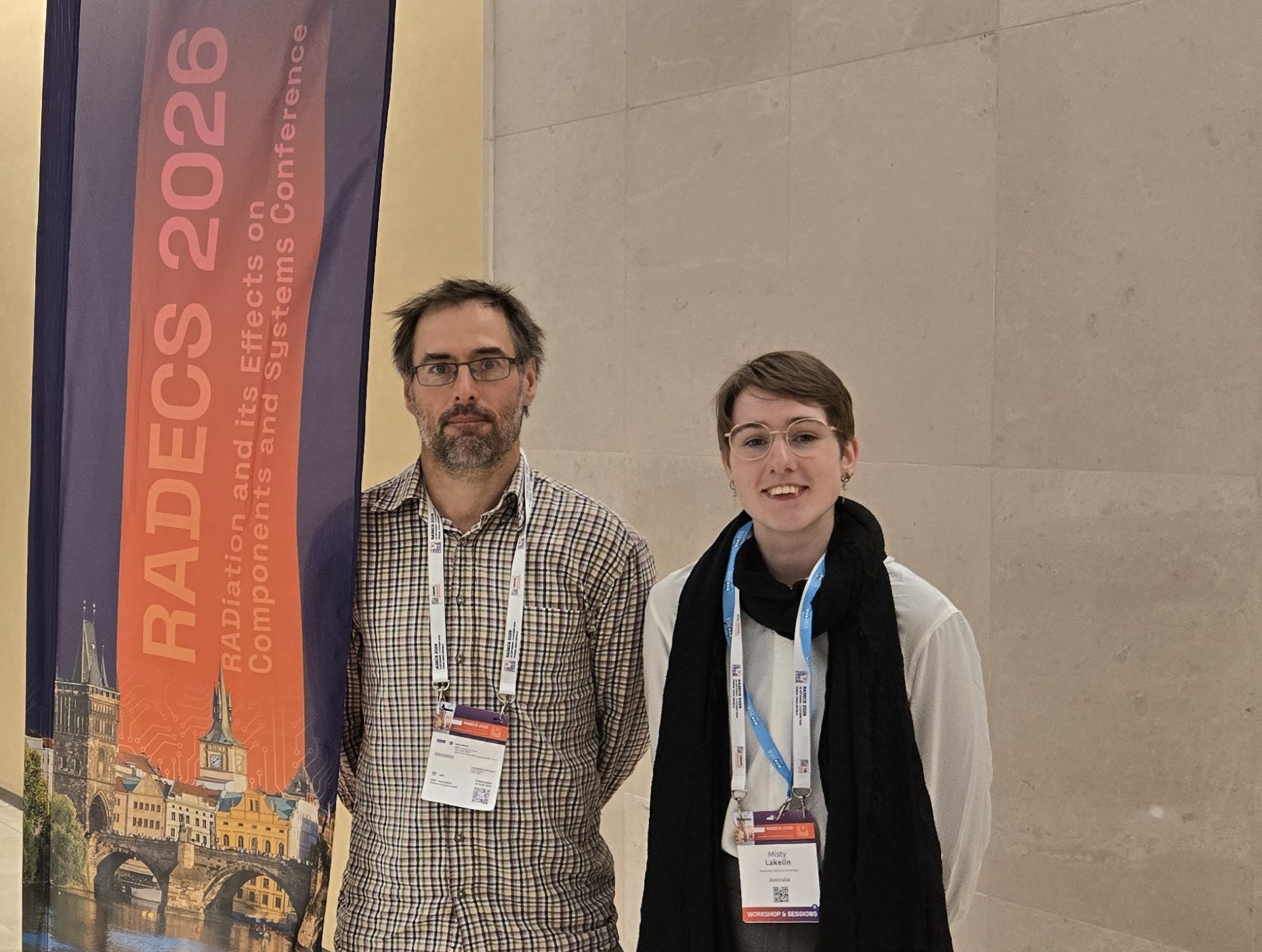
Members of our Space Irradiation Team were recently in Europe for the RADiation and its Effects on Components and Systems conference, RADECS 2026. This annual event, which attracts researchers, space companies, and space testing facilities from across the world, was held in Prague, Czech Republic.
HIA was represented by Space Team Lead Dr Daniel Bennett and Technical Officer Misty Lakelin, who presented a poster showcasing the capabilities of our Space Irradiation Beamline hosted at the ANU Heavy Ion Accelerator Facility (HIAF).
The conference was a great opportunity to debut the HIAF Space Beamline across the equator. The beamline and HIAF’s flexibility and versatility piqued the interest of many European and North American companies and researchers as well as fellow test facilities.
Our team found it particularly valuable to hear from speakers about the effects of radiation on electronic devices, given the increasing demand for testing electronics for a wide range of users in the past few years at HIAF. The team also made new connections and enjoyed networking with like-minded professionals.
While in Europe, Misty took the opportunity to visit some HIAF collaborators and former colleagues at their accelerator facilities.
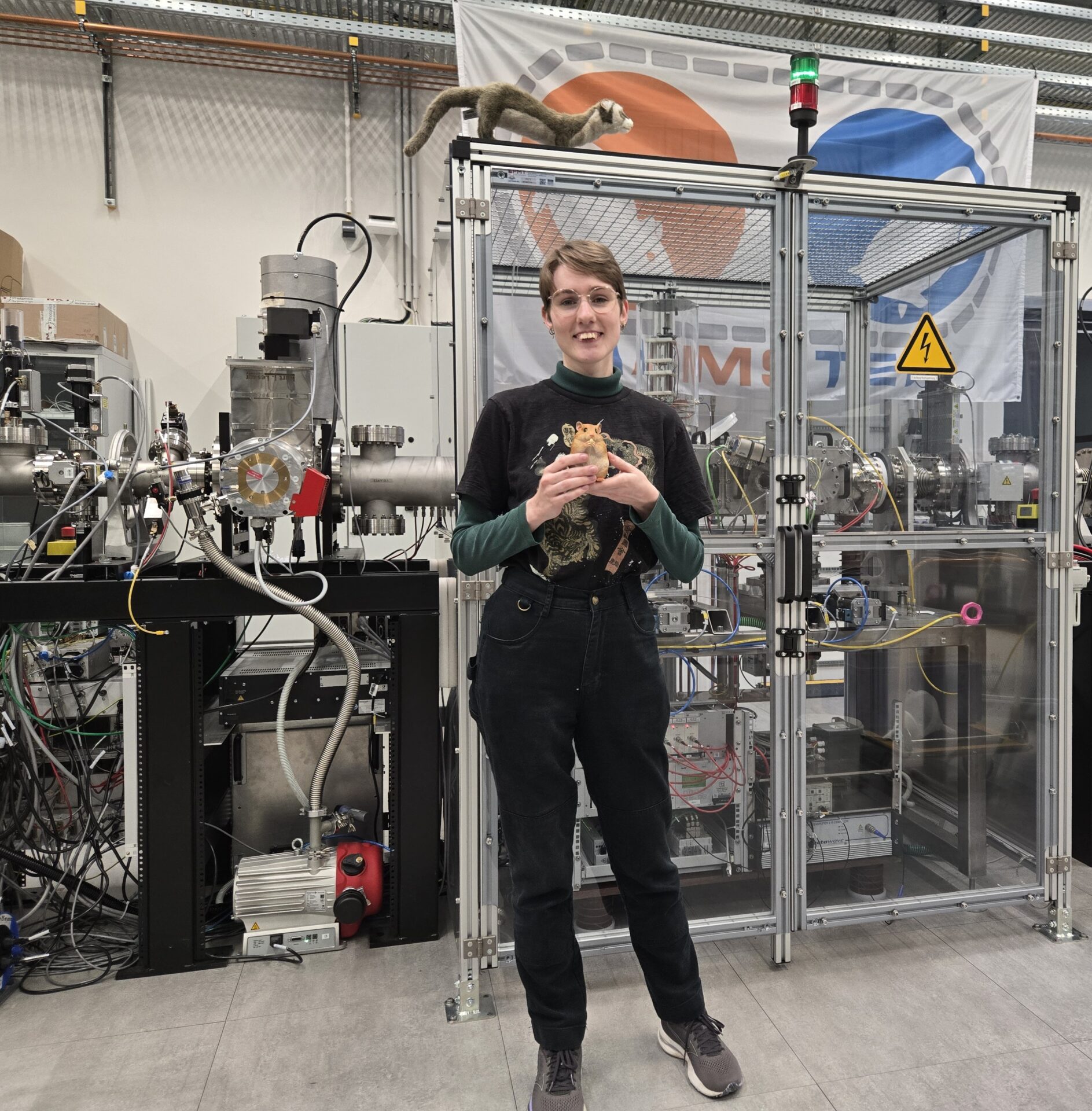
Firstly, at Helmholtz-Zentrum Dresden-Rossendorf (HZDR) in Dresden, Germany, she visited their Accelerator Mass Spectrometry (AMS) and Isotope Research Department, led by Prof Anton Walner. His team are close collaborators with the AMS group at HIAF and one of our regular users. Misty toured their new HAMSTER facility which is currently under construction and features an ion cooler and laser-based isobar suppression system. These instruments use a laser and bending magnet to remove or ‘suppress’ unwanted ions from a beam. It was highly educational to see how a new accelerator facility comes together while integrating specialised instrumentation.
Misty’s trip finished in Zurich, Switzerland where Dr Lauren Bezzina, former Industry Innovation Fellow at The Australian National University, now holds a post-doctoral position at ETH Zurich.
Lauren was instrumental in the early years of the HIAF Space Irradiation Beamline, from the design stages to its first two years of serving users. She is now working on integrating laser-based isobar suppression into a highly compact mini radiocarbon dating system (MICADAS) at the ETH Ion Beam Laboratory. This facility hosts a fascinating variety of accelerator systems for specialised AMS and Ion Beam Analysis applications.
Meeting with Lauren and touring the labs was an opportunity for Misty to draw on her technical expertise and retrospective view of operating the Space Beamline.
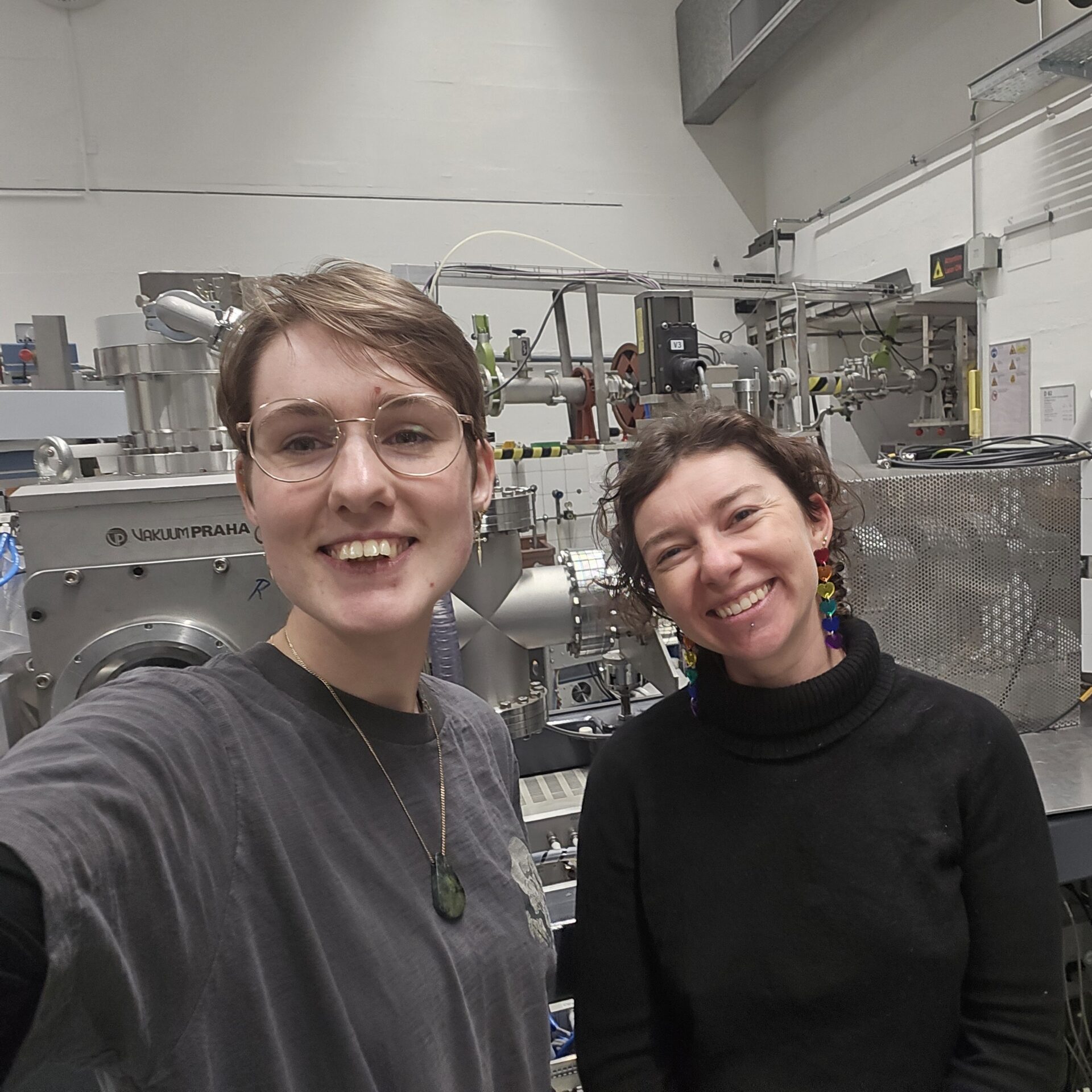
We would like to thank Prof Anton Walner, Dr Dominik Koll, Dr Lauren Bezzina and their teams for their hospitality in hosting Misty at their facilities and their insightful conversations.
Misty’s trip was made possible thanks to the Trevor Ophel Innovation Award which she received last year through the Heavy Ion Accelerator Facility Endowment Fund. The fund provides technical staff in the ANU Department of Nuclear Physics and Accelerator Applications with career development opportunities that might not otherwise be available.